

Reference: Greenwood, Val D. “Language, Terminology, and
Important Issues.” In The Researcher’s
Guide to American Genealogy, 4th ed., 29-56. Baltimore:
Genealogical Publishing, 2017.
Several years ago, I traced my Horton line back to Joseph
Horton, who died in Roane County, Tennessee between the time he wrote his will
on 29 June 1812 and April 1813, when an inventory of his estate was filed [1].
Other documents suggested he lived in
the area of Knox County that became Roane County in 1803, but finding anything
about him before that timeframe was difficult.
Given the area’s history, I knew it was unlikely that he was born in
Tennessee, but discovering where he lived before coming to Tennessee was a source of never-ending frustration for several years.
In his will, Joseph named the following heirs:
Mary Horton, wife
James, youngest son
Joseph, son of James
Hannah Terry, daughter
John Horton, son
Polly Gladden, daughter
Nancy Cooner, daughter
Heirs of William Horton, son
Sally Coulter, daughter
Rebecca Burk, daughter
Peggy Breshear, daughter
Phebe Walker, daughter
The will and inventory do not name his daughters’ husbands,
and no other estate records survive. In an attempt to research the family, and
hoping to establish a FAN club, I searched Tennessee records for each of the
children. I easily found marriage records
for Rebecca and Peggy, both of whom married in East Tennessee, but I had
trouble locating marriage records for the other children, including his sons.
I finally had a breakthrough when research led me to believe
a man named John Colter, who lived in East Tennessee in the 1790’s, was a
possible associate of Joseph Horton. Aha!
Could this man be a relative of the Colter that Sally Horton had married? Vertical
files at the McClung Library in Knoxville suggested that John Colter came from
North Carolina. Armed with that first
name, I began searching for marriage records in North Carolina, and found a marriage bond filed in Lincoln County on 22 Oct 1789 for John Colter and Sarah Horton.[2]
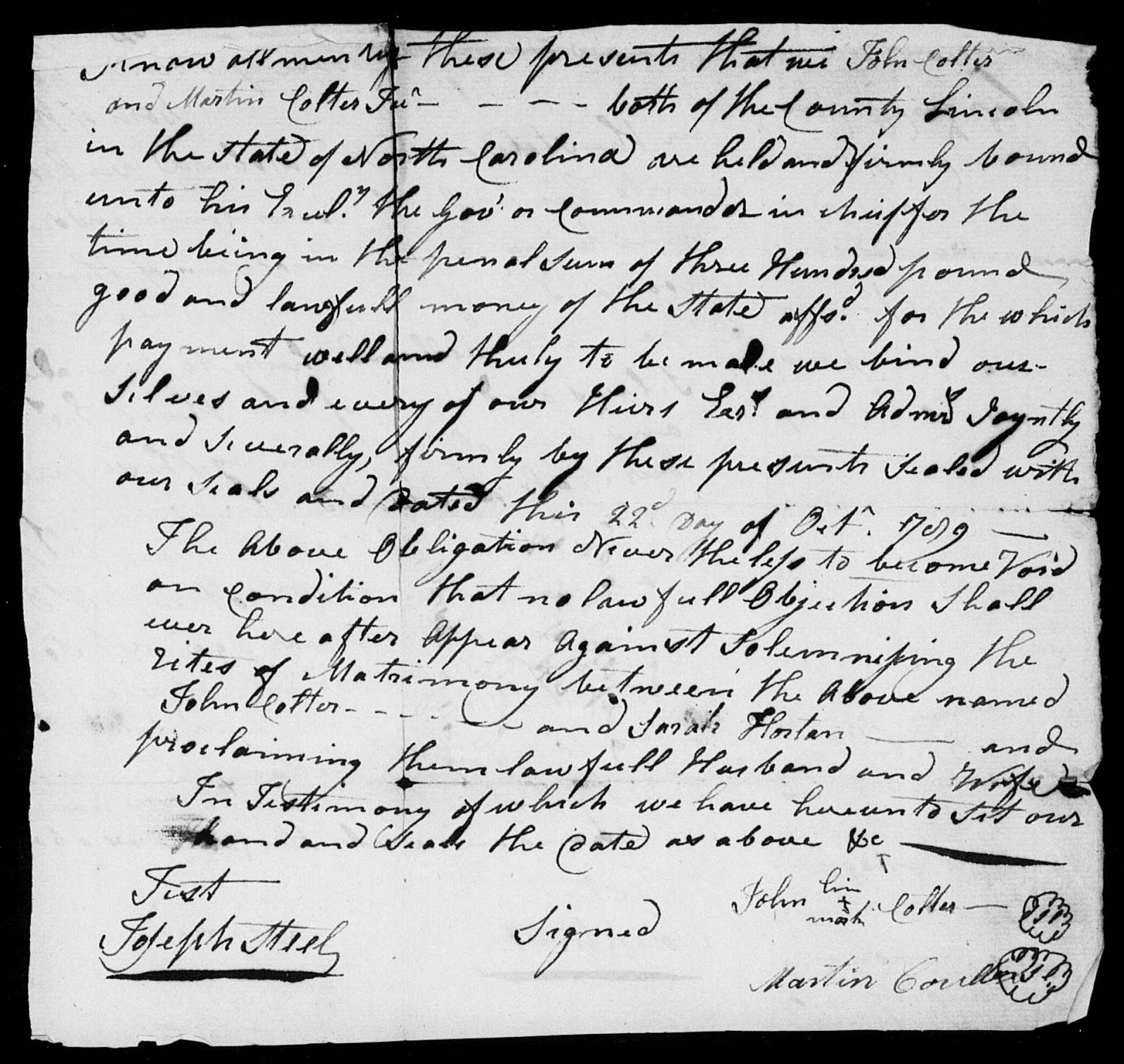 |
| Marriage Bond for John Colter and Sarah Horton, 1789 |
Since Sally was often a nickname for
Sarah, I knew this was not conflicting evidence and continued my research on
John Colter. I found him on the 1790
census of Lincoln County, and one of his neighbors is Joseph Horton![3]
 |
| Joseph Horton and John Colter, 1790 Census for Lincoln County, North Carolina |
[1]
Historical Records Project, “Estate Books, 1802-1842, Roane County, Tennessee,”
pages 25-26, entry for Joseph Horton; digital images, “Tennessee, Wills and
Probate Records, 1779-2008,” Ancestry
(http://www.ancestry.com : accessed 18
February 2018).
[2]
"North
Carolina, County Marriages, 1762-1979," database with images, FamilySearch (https://familysearch.org/ark:/61903/3:1:S3HY-63YW-9FZ?cc=1726957&wc=QD8P-6LB%3A1588772824%2C1588772826
: 22 December 2016), Lincoln > Marriage bonds, 1779-1868, vol C-D > image
485 of 968.
[3]
1790 U.S. census, Lincoln County, North Carolina, 4th Company, p.
111, col. 2; digital images, Ancestry (http://www.ancestry.com
: accessed 18 February 2018), image 2 of 11, citing FHL film 0568147.


